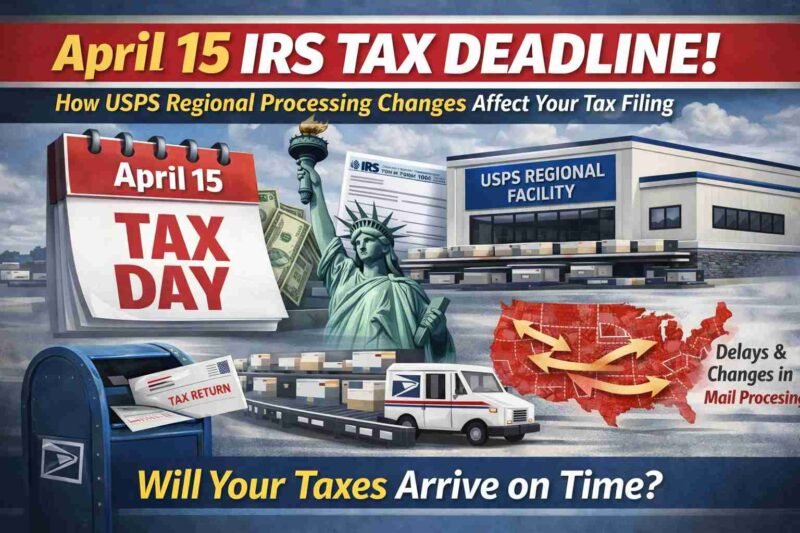
April 15 IRS Tax Deadline: Taxpayers who are mailing their paper tax returns this year will want to take a few precautions because of changes to the postal service that may cause the postmark on some returns to be delayed. I recommend you to mail your tax returns at least several days before April 15; if you owe taxes and your return is filed after the original due date, you may be subject to penalties for late filing. Filing electronically or filing an extension are better options than sending your return via mail at the last minute. Taxpayers should plan ahead to help prevent delays in mailing their tax return at the last minute.
USPS Postmark Changes Risk Your April 15 Tax Deadline: Mail Early
The April 15 IRS Tax Deadline to file income taxes is bringing some risk to taxpayers that rely on USPS mail which continue to be adjusted by the United States Postal Service (USPS) causing delays in processing and bringing uncertainty to the potential time frame for acceptable returns that are mailed as well as now exposed to penalties for late filing of returns.
In past years, the IRS has considered a timely filed return as postmarked before midnight on April 15; however, recent USPS and IRS changes may result in a mail piece not being officially postmarked until after midnight due to processing delays at one or more regional-processing centers through which the mail which has been routed; i.e., additional time from the date of mailing until postmarked. When mailing a tax return at the last minute, the taxpayer can now run the risk that the tax return will not be considered timely filed.
April 15 IRS Tax Deadline: What changed by USPS
The USPS implemented regional processing centers to make mail processing easier and quicker but unfortunately these changes affect when postmarks can apply to tax returns. As we all know, the postmark may be effective up to a day after you drop off your envelope at your local post office or mailbox.
However, under the new system, although the IRS will honor a timely postmarked envelope if it has been addressed and stamped correctly, many of these envelopes will be processed through automated regional processing centers and so not through your local office.
This change creates a situation where envelopes stamped April 15 that are mailed after the close of business on April 15, may be postmarked April 16, causing the taxpayer to incur late-filing penalties. Taxpayers can mitigate the impact of this change by submitting returns directly to a postal clerk for a manual postmark on the same day of submission; by using Certified or Registered Mail with a dated receipt; or by using e-filing to avoid any need for postmarks.
How many taxpayers could be affected?
Around 10 million US taxpayers file paper returns each year, roughly 6% of all individual filings, and all of them could face issues from USPS regional postmark delays near the April 15 deadline. Filing at the end of the filing period is when individuals experience the greatest risk of having their envelopes mailed on or after the deadline, as envelopes mailed on April 15 may not receive postmarking until April 16 or beyond. Although the IRS does not currently keep track of how many individuals will be affected, millions of individuals continue to file their returns by mail, despite the fact that e-filing completely dominates the market (94%) nationwide.
Also Read: Why you need Cyber Insurance and what you should know
April 15 IRS Tax Deadline: Penalties explained
Late filing penalty: for every month that you file your tax return late (no matter how late), the IRS will penalize you by 5% of the taxes due (a maximum of 25%). If you are more than 60 days late to file, you will be subject to a minimum penalty ($525 or the amount of taxes due). Failure to pay penalty: If you owe taxes and do not pay them on time, you will be charged a penalty of .5% for each month of non-payment (a maximum of 25%).
However, if you have not paid by the 10th day after receiving an IRS notice of no payment, the penalty will increase to 1%. Interest accrued on unpaid tax will be charged separately from penalties based on the IRS formula of a federal short-term interest rate of 3% compounded daily, and during the first three months of the current year, the interest has been at approximately 7%.
How to reduce the risk of late filing
- To reduce potential issues when filing taxes, in my opinion you should be planning ahead by sending your return early.
- Use certified mail with tracking for evidence of mailing time.
- E-filing reduces uncertain time to process through the mail.
- If you have to mail your return, by visiting the Post Office and verifying how and when the return will be stamped you will feel more confident that it will be timely filed.
- With the tax deadline quickly approaching, being familiar with the impact the changes in the US Postal Service may have on filing timely could mean the difference between timely filing and penalties.
- Planning your filings is getting more important than ever.
USPS Delay: Tax‑filing changes raise cybersecurity risks
As the IRS and USPS push more taxpayers toward electronic filing to avoid mail delays, the digital tax‑filing ecosystem becomes a bigger target for cybercriminals. Phishing emails, fake tax portals, and malware‑laden “tax form” downloads spike every filing season, aiming to steal SSN, bank details, and refund money.
To protect yourself when filing online:
- Use strong, unique passwords and 2‑factor authentication on every tax and financial account.
- Avoid clicking links in unsolicited “urgent tax” or “IRS refund” emails; always log in directly at the official IRS website.
- Enroll in the IRS Identity Protection PIN (IP PIN) program so thieves cannot file a return in your name even if they steal your SSN.
FAQ’s on April 15 IRS Tax Deadline
Will a postmark delay make my IRS tax return late?
Depending on where you mailed your April 15th return from, the USPS could have postmarked it with the date of April 16th; the IRS considers these returns to be filed late unless you have a manual postmark or Certified Mail receipt.
How can I obtain a same-day postmark?
Request for a hand-cancelled postmark from a postal service representative when you deliver your mail and do not use drop boxes.
What are the penalties for filing my tax return late?
5% monthly penalty of on unpaid taxes (maximum penalty is 25%), in addition to a 0.5% penalty on taxes not paid by due date; interest added daily. The minimum penalty is $525 if the tax returns are over 60 days past due
Can I e-file to avoid this issue?
Yes, 94% of taxpayers do this, e-filed tax returns receive instant time stamps and quicker refunds than paper-filed returns.
How does cybersecurity relate to mailing or e‑filing near April 15?
As USPS delays make mailed returns riskier, more people file electronically—creating more phishing emails, fake tax‑portal sites, and malware attacks aimed at stealing Social Security numbers and refund data around tax‑season time.
What cybersecurity steps should I take when e‑filing?
Use strong, unique passwords with 2‑factor authentication on IRS and tax‑prep accounts, avoid clicking links in unsolicited tax‑related emails, and avoid public Wi‑Fi when uploading sensitive documents. Enroll in the IRS Identity Protection PIN (IP PIN) program to block fraudulent returns in your name.
About The Author