Cyber Insurance for Manufacturers: Ask a manufacturing business owner what keeps them awake at night, and cybersecurity is not always the first answer. More often, the conversation revolves around labor shortages, rising operating costs, production delays, supply chain disruptions, equipment failures, and customer deadlines. Those are the challenges that affect daily operations and revenue. Yet over the past few years, another risk has quietly moved into the same category: cyberattacks.
For manufacturers, a ransomware incident is no longer a headline that happens to someone else. It has become a practical business concern. A cyberattack can disrupt production schedules, lock employees out of critical systems, delay shipments, and create unexpected expenses that extend far beyond the IT department. In many cases, the biggest losses are not related to stolen data at all. They come from operational downtime and the inability to deliver products to customers on time.
This growing reality is one reason more manufacturers are exploring cyber insurance. The challenge is that many business leaders have only a general understanding of what these policies actually cover. Some assume cyber insurance will absorb every financial loss after an attack. Others believe purchasing a policy removes the need to invest in cybersecurity controls. Both assumptions can create problems when a real incident occurs.
Understanding what cyber insurance does and what it does not do is essential for manufacturers evaluating their overall risk management strategy.
Why Cyber Insurance Is Becoming a Boardroom Discussion
Ten years ago, cyber insurance was often viewed as a niche product purchased primarily by technology companies, financial institutions, or large enterprises. Today, the conversation looks very different. Manufacturing companies of all sizes are being asked questions about cybersecurity by customers, insurers, auditors, and business partners.
The reason is straightforward. Manufacturing operations have become increasingly dependent on technology. Production schedules are often managed through ERP platforms. Inventory systems track materials in real time. Engineering teams share digital files across multiple locations. Vendors may access systems remotely to support equipment maintenance. These technologies improve efficiency, but they also create new avenues for cyber risk.
When people hear the phrase “cyberattack,” they often imagine stolen customer records. In manufacturing environments, the immediate concern is often operational disruption. If employees cannot access scheduling systems, production data, or critical files, business operations can slow dramatically. Even companies with modern equipment can struggle if the digital systems supporting those operations become unavailable.
That reality has pushed cybersecurity discussions beyond the IT department. Business owners, operations leaders, compliance managers, and executive teams are increasingly treating cyber risk as a business continuity issue rather than a purely technical problem.
A Scenario That Feels Uncomfortably Familiar
Imagine a mid-sized manufacturer that supplies components to multiple customers across the country. The company has modern production equipment, a cloud-based ERP platform, and a small internal IT team supported by outside vendors.
On a Monday morning, an accounting employee receives what appears to be a routine email from a long-term supplier. The message references an invoice and requests a quick review of an attached file. Nothing about the email seems unusual. The supplier’s name is familiar, the formatting looks professional, and the request appears legitimate.
The employee opens the attachment.
Over the next several days, attackers quietly move through the network, collecting credentials and identifying critical systems. By the time the company realizes something is wrong, key files have been encrypted and employees can no longer access important operational systems. Production schedules become unavailable, customer orders cannot be processed normally, and management is forced into crisis mode.
At that point, the financial impact is no longer limited to the IT department. Lost production time, delayed deliveries, emergency consulting costs, and customer concerns quickly become business problems.
Scenarios like this are one reason cyber insurance has become part of broader discussions about operational resilience.
What Cyber Insurance Typically Covers
Cyber insurance is designed to help organizations manage certain financial consequences associated with cyber incidents. While coverage varies between providers, most policies address costs that arise after an event has occurred.
| Coverage Area | Example of Potential Protection |
|---|---|
| Incident Response | Cybersecurity experts investigate how the attack occurred. |
| Data Recovery | Costs associated with restoring systems and recovering data. |
| Business Interruption | Financial losses resulting from operational downtime. |
| Legal Support | Legal expenses related to cyber incidents and investigations. |
| Customer Notification | Costs associated with notifying affected individuals. |
| Crisis Communications | Public relations support following a major incident. |
| Certain Ransomware Expenses | Coverage may apply depending on policy terms and conditions. |
For many manufacturers, business interruption coverage receives the most attention because downtime can become expensive very quickly. A cyberattack that interrupts production for several days may affect revenue, customer commitments, and supplier relationships simultaneously.
What Cyber Insurance Often Does Not Cover
One of the most important lessons for manufacturers is that cyber insurance is not a blank check. Policies contain limitations, exclusions, and requirements that deserve careful review.
| Common Exclusion | Why It Matters |
| Known Security Problems | Ignoring serious vulnerabilities may affect claims. |
| Intentional Misconduct | Deliberate illegal actions are generally excluded. |
| Failure to Maintain Required Controls | Certain safeguards may be required by the insurer. |
| Prior Known Incidents | Previously known events may not qualify for coverage. |
| Certain Contractual Penalties | Coverage varies significantly depending on policy language. |
| Some Regulatory Fines | Coverage depends on policy terms and applicable regulations. |
Many organizations focus heavily on what a policy includes while spending less time reviewing exclusions. That can create unpleasant surprises during a claim process. Manufacturers should understand not only what coverage exists, but also the conditions required to maintain that coverage.
Why Insurers Are Asking Tougher Questions
Several years ago, obtaining cyber insurance was often a relatively simple process. That has changed significantly. As ransomware incidents and cyber-related claims increased, insurers responded by examining cybersecurity practices more closely.
Today, insurers commonly ask questions about multi-factor authentication, backup procedures, employee security training, incident response planning, and vulnerability management. Some carriers may even require evidence that certain controls are in place before providing coverage.
This shift reflects a simple reality. Insurance companies prefer to work with organizations that actively manage risk. Businesses that invest in cybersecurity controls often present lower risk profiles than those that rely entirely on insurance as a safety net.
From a manufacturing perspective, this means cybersecurity and cyber insurance are becoming increasingly interconnected. Strong security practices can influence both insurability and policy terms.
Why Manufacturing Presents Unique Challenges
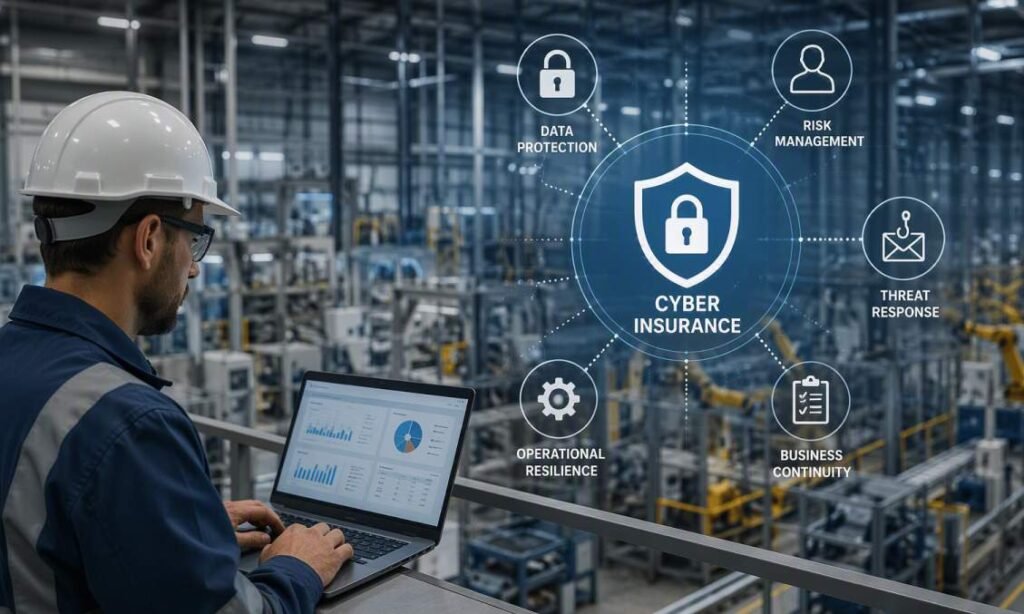
Manufacturing environments rarely resemble traditional office settings. Production facilities often contain a mix of modern systems and legacy technologies that have been operating successfully for years. Replacing these systems is not always practical, especially when they remain essential to production.
Many facilities also rely on third-party vendors for maintenance, software updates, and equipment support. Remote access connections may be necessary for operational reasons, but they can also create additional security considerations.
Another challenge involves operational technology. While traditional IT systems support business functions such as email and accounting, operational technology directly supports manufacturing processes. A cyber incident affecting operational technology can create consequences that extend beyond data loss and directly impact production activities.
These realities make cybersecurity and by extension cyber insurance particularly important for manufacturing organizations.
Cyber Insurance Works Best Alongside Strong Cybersecurity
One of the most common misconceptions about cyber insurance is that purchasing a policy solves the cyber risk problem. In reality, insurance is most effective when combined with practical cybersecurity controls.
Organizations should continue investing in employee awareness training, secure backups, access controls, vulnerability management, multi-factor authentication, and incident response planning. These measures help reduce the likelihood of an incident while also improving recovery capabilities if an attack occurs.
Cyber insurance helps manage financial consequences. Cybersecurity helps reduce the probability and severity of incidents. The two strategies complement one another rather than compete.
Questions Manufacturers Should Ask Before Purchasing a Policy
Before selecting a cyber insurance policy, manufacturers should have a clear understanding of both coverage and operational expectations.
Important questions include:
- Does the policy include business interruption coverage?
- How does the insurer define a covered cyber incident?
- What cybersecurity controls are required?
- Are third-party vendor incidents covered?
- How are ransomware-related claims handled?
- Are operational technology environments included?
- What exclusions are most relevant to manufacturing businesses?
A policy should be evaluated based on the organization’s actual risk profile rather than price alone.
Final Thoughts
Cyber insurance has become an increasingly important part of risk management for manufacturers, but it should not be viewed as a replacement for cybersecurity. The most resilient organizations understand that insurance and cybersecurity serve different purposes. One helps reduce the financial impact of incidents, while the other helps reduce the likelihood and severity of those incidents occurring in the first place.
For manufacturers operating in today’s digital environment, the conversation is no longer about whether cyber risk exists. The more practical question is how prepared the organization is to respond when a cyber event occurs. Businesses that combine strong cybersecurity practices with appropriate insurance coverage are generally better positioned to recover from incidents, maintain customer trust, and keep operations moving forward.
FAQ’s on Cyber Insurance for Manufacturers
Does cyber insurance cover ransomware attacks?
Many policies provide some level of ransomware-related coverage, but coverage terms, exclusions, and conditions vary significantly between insurers. Businesses should carefully review policy details before assuming specific costs are covered.
Is cyber insurance mandatory for manufacturers?
Cyber insurance is typically not required by law. However, customer contracts, industry expectations, and risk management considerations may make coverage beneficial.
How much cyber insurance coverage does a manufacturer need?
The appropriate coverage amount depends on factors such as company size, revenue, operational dependence on technology, contractual requirements, and overall risk exposure.
Can a cyber insurance claim be denied?
Yes. Claims may be affected if policy requirements are not met, required security controls are absent, or exclusions apply to the specific incident.
Disclaimer
This article is for informational purposes only and should not be considered legal, insurance, cybersecurity, compliance, or financial advice. Insurance coverage varies by provider and policy. Manufacturers should consult qualified insurance professionals and cybersecurity advisors before making coverage decisions.
Official Sources
- Federal Bureau of Investigation Cyber Division: https://www.fbi.gov/investigate/cyber
- Cybersecurity and Infrastructure Security Agency (CISA): https://www.cisa.gov
- National Institute of Standards and Technology (NIST): https://www.nist.gov
- NIST Cybersecurity Framework: https://www.nist.gov/cyberframework
- Department of Defense CMMC Program: https://www.acq.osd.mil/cmmc/
About The Author