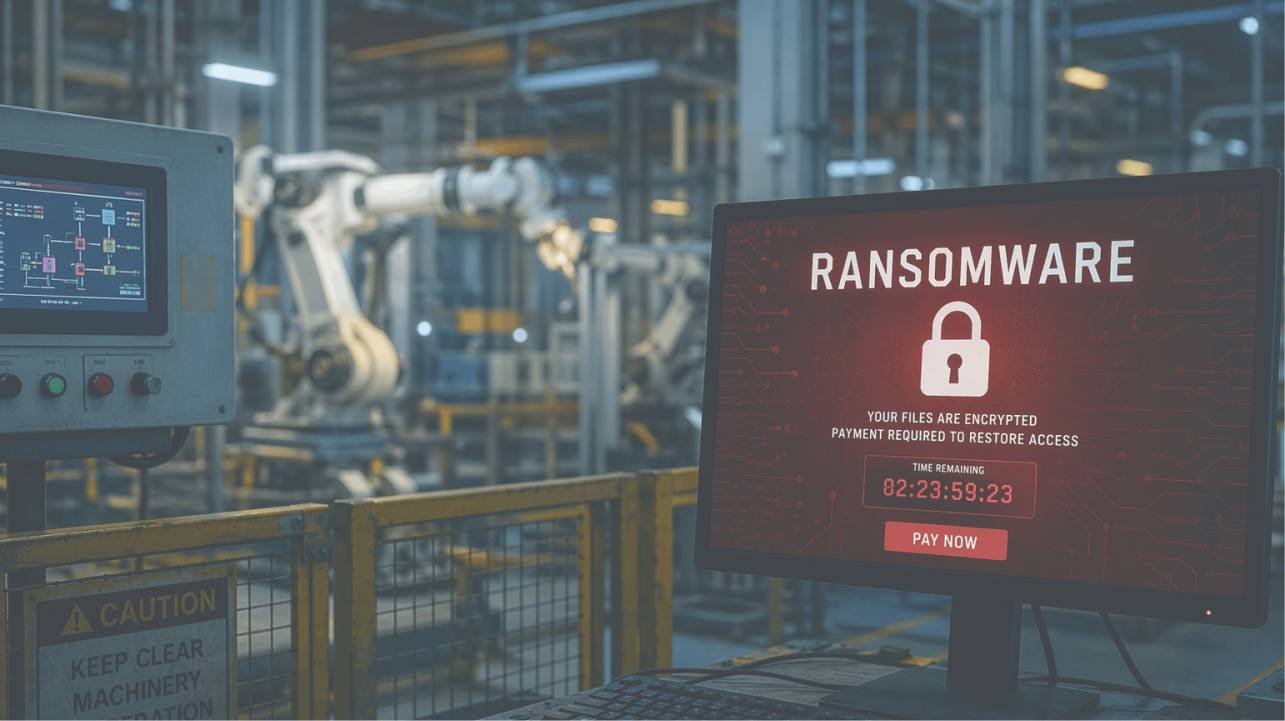
Why Manufacturers Are Prime Targets for Ransomware: A decade ago, many manufacturing companies viewed ransomware as a problem for banks, hospitals, or large technology firms. Today, that assumption no longer holds true. Manufacturing has become one of the most frequently targeted sectors for ransomware attacks worldwide, with organizations of all sizes finding themselves in the crosshairs of cybercriminal groups.
The reason is not difficult to understand. Modern manufacturers depend on continuous operations, interconnected systems, digital supply chains, and specialized equipment that cannot remain offline for long. When production stops, the financial impact begins almost immediately. Cybercriminals understand this reality and increasingly see manufacturers as organizations that may feel pressured to restore operations as quickly as possible.
For business owners, plant managers, and operations leaders, ransomware is no longer just a cybersecurity concern. It is a business continuity issue that can affect production schedules, customer commitments, supplier relationships, and long-term profitability.
Manufacturing Has Changed Dramatically
Manufacturing environments today look very different from those of twenty years ago. Production facilities increasingly rely on connected technologies to improve efficiency, reduce downtime, and provide real-time visibility into operations. Enterprise resource planning (ERP) systems, cloud applications, industrial control systems, inventory platforms, and remote monitoring tools have become essential parts of daily operations.
While these technologies deliver significant business benefits, they also create additional entry points for attackers. Every connected system represents a potential pathway into the organization. Cybercriminals no longer need physical access to a facility to cause disruption. In many cases, a single compromised account or vulnerable system can provide access to critical business functions.
Many manufacturers also operate with a mixture of modern and legacy technologies. Older production systems may still perform their intended functions effectively, but they were often not designed with modern cybersecurity threats in mind. As a result, organizations may find themselves balancing operational requirements with security challenges that become more difficult to manage over time.
Downtime Is Expensive and Attackers Know It
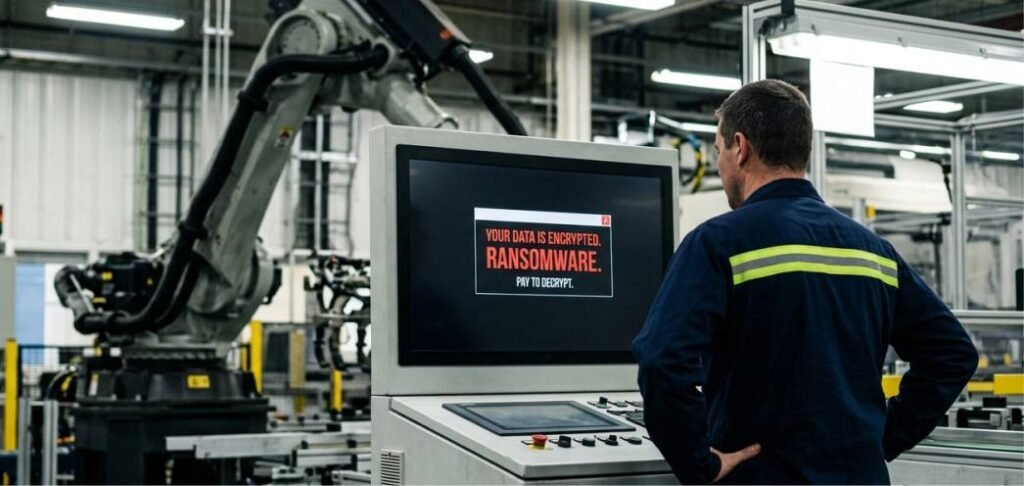
One of the biggest reasons manufacturers attract ransomware groups is the cost of downtime. In many industries, a temporary system outage is inconvenient. In manufacturing, it can be devastating.
Production schedules are often built around strict deadlines, customer commitments, and carefully coordinated supply chains. If ransomware prevents employees from accessing production data, inventory records, engineering files, or scheduling systems, operations can slow dramatically or stop entirely.
Imagine a manufacturer producing components for the automotive industry. If production is interrupted for several days, shipments may be delayed, contractual obligations may be missed, and customers may seek alternative suppliers. The financial consequences can extend far beyond the immediate costs of responding to the cyberattack.
Cybercriminals understand this pressure. They know that manufacturers frequently face difficult decisions when operations are halted, which is one reason ransomware attacks continue to target the sector.
Valuable Data Extends Beyond Customer Information
When people think about cybercrime, they often focus on stolen personal information or financial records. Manufacturers, however, possess a different type of valuable data.
Many organizations store intellectual property, engineering designs, product specifications, supplier agreements, pricing information, and proprietary manufacturing processes. In some cases, these assets represent years of research, development, and competitive investment.
Even if attackers never intend to sell this information, the threat of exposing or permanently losing valuable business data can increase pressure on victims during ransomware negotiations. Modern ransomware groups often combine data theft with file encryption, creating additional leverage over targeted organizations.
The Supply Chain Creates Additional Risk
Manufacturers rarely operate in isolation. They depend on a network of suppliers, logistics providers, software vendors, contractors, and customers. These relationships are essential for business operations, but they also create cybersecurity challenges.
A ransomware attack does not always begin with a direct compromise of the manufacturer itself. Attackers may first gain access through a third-party vendor, a managed service provider, or a trusted business partner. Once inside the broader ecosystem, they may look for opportunities to move laterally between connected organizations.
This interconnected environment means that cybersecurity weaknesses outside the organization can still create significant internal risks. As supply chains become increasingly digital, manufacturers must pay closer attention to third-party security practices and vendor risk management.
Human Error Remains a Major Entry Point
Despite advances in cybersecurity technology, many ransomware incidents still begin with human error. A phishing email, malicious attachment, or fraudulent link can provide attackers with the access they need to begin a broader compromise.
Manufacturing environments often involve employees with varying levels of technical expertise. Office staff, production supervisors, engineers, and plant personnel may all interact with email systems and digital tools differently. This diversity creates challenges when attempting to establish consistent cybersecurity awareness across the organization.
Attackers understand that they do not always need sophisticated techniques to gain access. In many cases, a convincing email and a moment of distraction are enough to initiate an attack.
Common Weaknesses Found in Manufacturing Environments
While every organization is different, several cybersecurity challenges appear frequently across the manufacturing sector.
| Common Weakness | Why It Creates Risk |
|---|---|
| Legacy systems | Older technology may lack modern security protections. |
| Weak passwords | Compromised credentials can provide direct access to systems. |
| Limited IT resources | Small teams may struggle to monitor threats effectively. |
| Unpatched software | Known vulnerabilities can remain exposed for extended periods. |
| Vendor access | Third-party connections can create additional attack paths. |
These issues do not guarantee a ransomware attack, but they can increase the likelihood of a successful compromise if not addressed proactively.
The Business Impact Goes Beyond Recovery Costs
Many discussions about ransomware focus on the ransom payment itself. In reality, the broader business impact is often much more significant.
A ransomware incident may lead to production delays, lost revenue, overtime expenses, regulatory obligations, customer dissatisfaction, legal costs, and reputational damage. Management teams may spend weeks dealing with recovery efforts instead of focusing on growth initiatives and operational improvements.
For smaller manufacturers, the financial strain can be particularly challenging. Unlike larger enterprises with dedicated cybersecurity budgets and recovery resources, smaller organizations may have fewer options available during a crisis.
| Potential Impact | Business Consequence |
| Production downtime | Missed orders and delayed shipments |
| Data loss | Disruption to business operations |
| Recovery expenses | Increased technology and consulting costs |
| Customer trust issues | Potential loss of future business |
| Regulatory concerns | Compliance and reporting obligations |
| Reputation damage | Long-term impact on business relationships |
Understanding these broader consequences helps explain why ransomware has become a boardroom issue rather than solely an IT concern.
Reducing Ransomware Risk
There is no single solution that can eliminate ransomware risk entirely. However, manufacturers can significantly improve their resilience through a combination of cybersecurity controls, employee awareness, and operational preparedness.
Multi-factor authentication should be implemented wherever possible to reduce the risk of unauthorized access. Software updates and vulnerability management processes help close known security gaps before attackers can exploit them. Secure backups provide an essential recovery capability if systems become encrypted or compromised.
Employee training remains equally important. Workers who understand how to identify phishing emails, suspicious requests, and social engineering tactics can help prevent many incidents before they begin.
Organizations should also develop and regularly test incident response plans. Knowing how the business will respond during a cybersecurity emergency can reduce confusion and accelerate recovery efforts.
Wrapping-up
Manufacturers have become prime targets for ransomware because they combine valuable data, interconnected systems, and a strong dependence on operational continuity. Cybercriminals recognize that production disruptions can create significant financial pressure, making the sector an attractive target for extortion-based attacks.
While the threat landscape continues to evolve, manufacturers are not powerless. Organizations that invest in cybersecurity fundamentals, strengthen employee awareness, evaluate vendor risks, and prepare for potential incidents place themselves in a much stronger position to withstand modern ransomware threats.
In 2026, cybersecurity is no longer simply an IT responsibility. For manufacturers, it has become a critical component of operational resilience, business continuity, and long-term competitiveness.
FAQ’s on Why Manufacturers Are Prime Targets for Ransomware
Why do ransomware groups target manufacturers?
Manufacturers often rely on continuous operations and cannot afford extended downtime. Cybercriminals know that production disruptions can create significant financial pressure, making manufacturers attractive targets for ransomware attacks.
Are small manufacturers at risk of ransomware attacks?
Yes. Small and mid-sized manufacturers are frequently targeted because they may have fewer cybersecurity resources than larger organizations while still possessing valuable data and critical operational systems.
What is the most common way ransomware enters a manufacturing company?
Phishing emails remain one of the most common entry points. Attackers often use deceptive emails to steal credentials or deliver malicious software that can later be used to deploy ransomware.
How can manufacturers reduce ransomware risk?
Organizations can reduce risk by implementing multi-factor authentication, maintaining secure backups, applying software updates, training employees, and developing an incident response plan.
Disclaimer
This article is for informational purposes only and should not be considered legal, cybersecurity, compliance, or professional advice. Manufacturers should consult qualified cybersecurity professionals to assess their specific risks and security requirements.
Official Sources
- Federal Bureau of Investigation Cyber Division
- Cybersecurity and Infrastructure Security Agency (CISA)
- National Institute of Standards and Technology (NIST)
- NIST Cybersecurity Framework
- Department of Defense CMMC Program
About The Author