For many defense contractors, CMMC Level 2 compliance is no longer a future concern—it’s a business requirement. Companies that handle Controlled Unclassified Information (CUI) are increasingly finding that cybersecurity compliance is becoming just as important as the products and services they deliver.
Over the past few years, one trend has become clear: the biggest compliance challenges are rarely technical. Most organizations can purchase security software, enable multi-factor authentication, or deploy endpoint protection tools. The harder challenge is documenting those controls, maintaining evidence, tracking remediation efforts, and demonstrating compliance during an assessment.
That administrative burden is why Governance, Risk, and Compliance (GRC) platforms have become increasingly popular among defense contractors.
CyberComply L2, developed by Armada Cyber Defense, is one such platform. It is designed specifically around CMMC 2.0 Level 2 and the 110 security requirements contained in NIST SP 800-171 Rev. 2.
After reviewing the platform’s capabilities, what stands out is not necessarily the automation itself but the attempt to organize the entire compliance process into a single environment.
What is cybercomply L2?
CyberComply L2 is a cloud-based Governance, Risk, and Compliance (GRC) platform designed to help organizations achieve and maintain CMMC 2.0 Level 2 compliance. The platform manages all 110 NIST SP 800-171 Rev. 2 security controls and more than 320 assessment objectives required for protecting Controlled Unclassified Information (CUI).
The solution provides a structured compliance environment with built-in support for System Security Plans (SSPs), Plans of Action and Milestones (POA&Ms), evidence management, remediation tracking, and audit preparation.
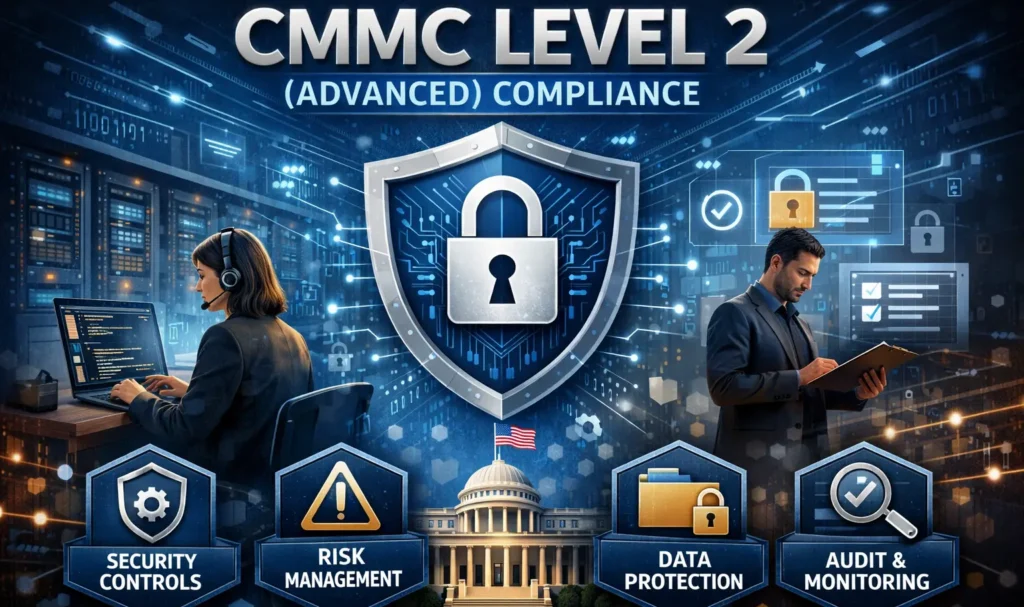
The Problem Most CMMC Projects Face
When people first hear about CMMC Level 2, they often focus on the number of controls.
There are 110 security requirements.
There are more than 320 assessment objectives.
There are 14 security domains.
While those numbers sound intimidating, they are usually not what causes compliance projects to stall.
The real challenge is coordination.
A typical contractor may have:
- Policies stored in Word documents
- Evidence saved in SharePoint
- Remediation tasks tracked in spreadsheets
- User access reviews managed through email
- Vulnerability reports stored in security tools
- System documentation spread across multiple teams
Individually, each process may work.
Collectively, they create a documentation problem.
When an assessor asks for evidence supporting a particular requirement, the information often exists somewhere. Finding it quickly is another matter.
A Realistic Example
Consider a 45-person manufacturing company that supplies components to a Department of Defense prime contractor.
The company receives engineering drawings that qualify as Controlled Unclassified Information.
Its IT environment includes:
- Microsoft 365 GCC High
- Company-managed laptops
- Endpoint protection software
- Multi-factor authentication
- Cloud backups
From a cybersecurity perspective, the company is in relatively good shape.
However, when management begins preparing for a future CMMC assessment, several questions emerge:
Who owns each compliance requirement?
Which controls have supporting evidence?
Which policies need updating?
What remediation items remain open?
Where is the latest version of the System Security Plan?
These are operational questions rather than technical ones.
Without a structured process, compliance efforts can become difficult to manage as the assessment date approaches.
Where CyberComply L2 Fits Into the Process
CyberComply L2 attempts to solve this organizational problem by providing a central workspace for compliance activities.
Instead of managing documentation through separate systems, users can connect controls, evidence, remediation tasks, policies, and assessment preparation activities together.
The platform is built around all 110 NIST SP 800-171 controls and associated assessment objectives.
For organizations that currently rely on spreadsheets and shared folders, this structure may be one of the platform’s most valuable features.
Rather than asking, “Where did we save that evidence?” teams can focus on the status of the control itself.
One Feature That Deserves More Attention: POA&M Management
Many software vendors highlight dashboards and automation.
In practice, one of the most useful compliance tools is often the humble POA&M.
A Plan of Action and Milestones (POA&M) tracks deficiencies that need remediation.
For example, imagine an internal review identifies that several privileged accounts do not have multi-factor authentication enabled.
Without a formal process, the issue might be documented in a spreadsheet and assigned through email.
Weeks later, leadership may be unsure whether the issue has been resolved.
CyberComply L2 automatically converts the finding into a remediation item with ownership, deadlines, status tracking, and supporting notes.
This may sound simple, but organizations managing dozens of compliance findings simultaneously can benefit significantly from structured tracking.
The Hidden Challenge of SSP Development
Ask compliance consultants which document causes the most frustration and many will immediately mention the System Security Plan (SSP).
An SSP is not merely a policy document.
It is a detailed description of how an organization protects sensitive information.
Many businesses begin with generic templates downloaded from the internet.
The result is often a lengthy document filled with information that does not accurately reflect the organization’s environment.
One of CyberComply L2’s more practical features is SSP generation based on scoping information.
If an organization identifies:
- Systems handling CUI
- Network boundaries
- Cloud environments
- Users
- Data flows
The platform can generate a more tailored SSP framework.
This does not eliminate the need for review, but it can reduce the amount of manual drafting required.
Evidence Collection: A Bigger Problem Than Most Organizations Expect
Evidence collection sounds simple until assessment preparation begins.
Consider a single access control requirement.
Supporting evidence might include:
- User access reviews
- Authentication settings
- Screenshots
- Security policies
- Audit logs
- Training records
Now multiply that across 110 security requirements.
Suddenly, evidence management becomes a major project.
CyberComply L2 allows organizations to attach documentation directly to controls and assessment objectives.
This creates a clear relationship between the requirement and supporting evidence.
During an assessment, that structure can save considerable time.
What the Platform Does Not Do
One mistake organizations sometimes make when evaluating compliance software is assuming the software creates compliance.
No platform can do that.
CyberComply L2 can help organize compliance activities.
It cannot:
- Implement security controls
- Write policies without review
- Conduct risk assessments automatically
- Train employees
- Pass an assessment on behalf of an organization
Human involvement remains essential.
Leadership commitment, security expertise, and operational discipline are still required.
Organizations considering any compliance platform should understand this distinction.
Preparing for a C3PAO Assessment
Many contractors focus heavily on implementation and underestimate assessment preparation.
A common scenario looks like this:
Months are spent deploying security controls.
A few weeks before the assessment, the organization begins gathering documentation.
Missing evidence is discovered.
Policies are outdated.
Open remediation items have unclear ownership.
Assessment preparation becomes stressful.
CyberComply L2’s Audit Readiness Mode is designed to address this challenge by encouraging organizations to maintain documentation continuously rather than assembling everything at the last minute.
For companies preparing for a future C3PAO assessment, this may be one of the platform’s most practical benefits.
Who Is Most Likely to Benefit?
The platform appears best suited for organizations that fall into one of three categories.
Small Defense Contractors
Smaller companies often lack dedicated compliance personnel.
A structured compliance platform can help reduce reliance on spreadsheets and manual tracking.
Growing Mid-Sized Contractors
Organizations with multiple departments frequently struggle with coordination.
Centralized compliance management can improve visibility across teams.
MSPs, MSSPs, and Consultants
The multi-tenant version allows service providers to manage multiple clients while maintaining separation between environments.
This can improve operational efficiency when supporting several compliance projects simultaneously.
Pricing Overview
CyberComply L2 Standard is priced at $399 per month with an annual commitment.
A quarterly billing option is available at $480 per month.
Organizations requiring multi-tenant functionality can choose the MSP-focused version, which starts at $575 per month plus additional instance fees.
Whether that pricing represents good value depends largely on the cost of current compliance management processes.
For organizations spending significant time managing spreadsheets, documentation, and evidence collection manually, the productivity gains may justify the investment.
Questions to Ask Before Purchasing Any CMMC Platform
Before selecting CyberComply L2—or any compliance platform—organizations should ask:
- How much time do we currently spend managing compliance documentation?
- Do we have a repeatable SSP maintenance process?
- Can we quickly locate evidence for any control?
- How are remediation activities tracked today?
- What challenges did we encounter during previous audits?
- Will multiple departments need access?
- Do we expect to support multiple business units or clients?
The answers often reveal whether a dedicated compliance platform is necessary.
Also Read: CyberGAP L1 & L2 by Armada Cyber Defense
Pricing & Upgrade
| Tier | Price | Billing | Details |
|---|---|---|---|
| L1 | $960/year | Annual only | FCI compliance; no monthly option |
| L2 Standard | $399/month | Annual commitment required ($4,788/yr) | Single-tenant CUI; full NIST 800-171 |
| L2 Multi-Tenant | $575/month + $200/additional instance | Annual commitment required | MSPs/C3PAOs; full client isolation |
| Multi-Year Discount | 20% off | All tiers | 2+ year contracts |
| L1 → L2 Upgrade | Prorated credit | Seamless | All L1 data/tasks carry forward |
| CyberGAP Import | Free | One-time | Gap results populate L2 instance |
| MSP Profit Share | 35% | Multi-tenant only | Revenue share on client subs |
Final Thoughts
CyberComply L2 is best viewed as a compliance management platform rather than a cybersecurity product.
Its value comes from helping organizations organize information, track progress, maintain documentation, and prepare for assessments.
For contractors pursuing CMMC Level 2 certification, those administrative tasks can consume a surprising amount of time and resources.
The platform will not eliminate the work required to achieve compliance. Organizations must still implement controls, train employees, manage risks, and maintain security programs.
What CyberComply L2 appears to offer is a structured framework that makes those activities easier to manage and easier to demonstrate during an assessment.
For companies currently struggling with spreadsheets, disconnected documentation, and manual compliance tracking, that organizational benefit may ultimately be the platform’s strongest selling point.
FAQ’s
What is CyberComply L2?
CyberComply L2 is Armada Cyber Defense’s enterprise GRC SaaS platform for CMMC 2.0 Level 2 compliance, automating management of 110 NIST SP 800-171 Rev 2 controls to protect CUI.
Who needs CMMC Level 2 certification?
It is required by DoD contractors handling Controlled Unclassified Information (CUI) in contracts.
What is the cost of CyberComply L2 ?
Pricing starts at $399/month (annual commitment) or $480/month (quarterly).
Is it suitable for small businesses?
Yes it is suitable for small businesses.
About The Author